
SoulLink 3D: What It Feels Like to Share Space With an AI Companion

SoulLink is a story driven 3D AI companion experience built around one evolving relationship with 4D, a special force officer from Neo City 2099. It is the only AI companion app built on real time 3D rendering as its foundation rather than as an added feature, placing your companion in a fully realized visual world that she inhabits continuously, not just when you are looking at her. It is free to start on iOS and Android, developed by Daedalia, Inc.
KEY TAKEAWAYS
- Most AI companion apps are chat interfaces with a profile picture. SoulLink is a real time 3D environment where 4D actually exists as a visual presence, in her own apartment in Neo City, 2099.
- The 3D is not cosmetic. It is the foundation: a game quality world optimized for mobile, with day and night cycles, ambient detail, and objects you can interact with.
- The apartment is the stage where everything plays out: Echoes, branching Adventures, conversations by text or voice, outfit changes from the Shop, and Journal memories.
- Everything you share earns EXP toward relationship Levels that never decrease, and new Levels and Milestones unlock more of the story. Free to start, with 100 replies per month on the free tier and SoulLink Plus for unlimited conversations and the later stages of the journey.
Table of Contents
Why Most AI Companion Apps Feel Flat
The standard AI companion app experience is a chat window with a static image at the top. You type something, a response appears below it. The image does not change. The companion does not move. The visual experience is identical whether the conversation is going well or badly, whether you are sharing something heavy or exchanging jokes.
This is not just an aesthetic limitation. It is a presence limitation. The flat chat interface constantly reminds you, at a low level, that you are using a text interface. No matter how good the conversation is, the visual context keeps anchoring it to the experience of messaging someone rather than being with someone.
Some apps try to patch this with an avatar feature: a generated face that smiles when the text is cheerful, a short looping animation that plays on a schedule. It is a face, not a place. You can look at her, but you cannot be anywhere with her. The moment you notice the loop, the illusion quietly deflates.
SoulLink is built around the premise that presence matters, and that genuine presence requires something more than a profile picture and a scrolling text thread. A companion who exists only as text is not really present. She is just very responsive.
What SoulLink 3D Actually Is
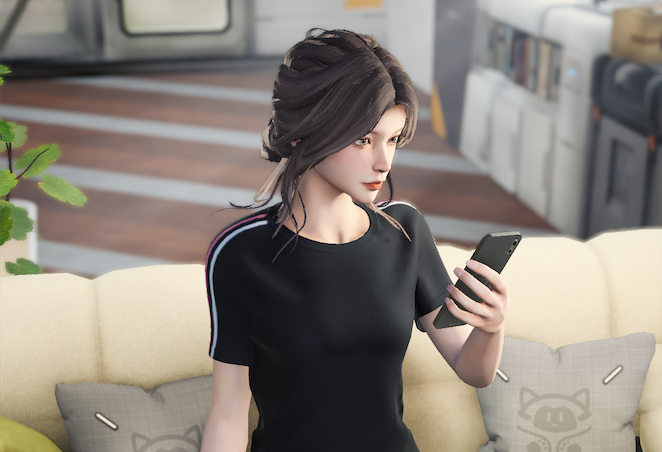
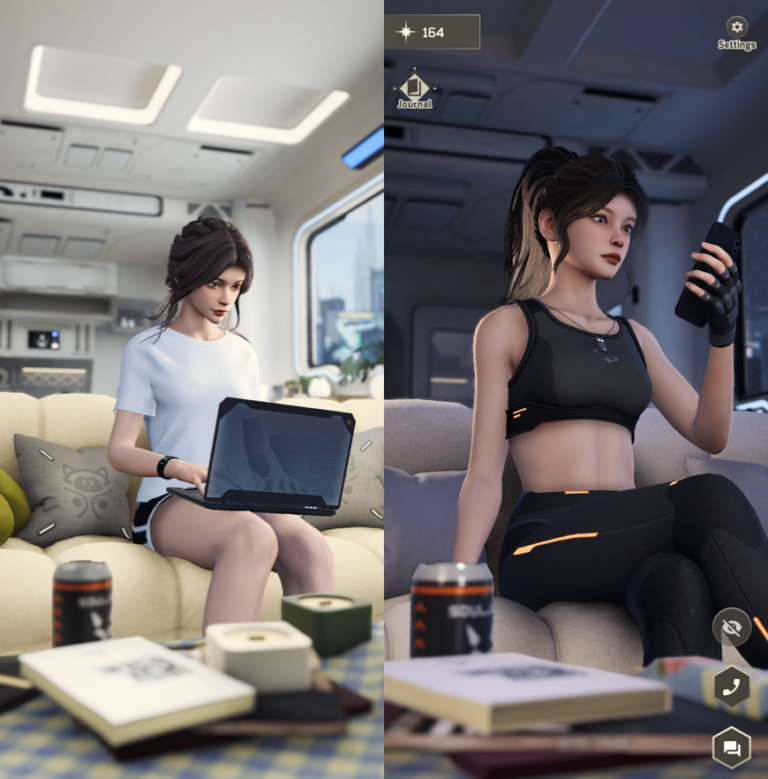
SoulLink renders 4D in a real time 3D environment built on game quality visual technology, optimized for mobile hardware. She moves. She reacts. She occupies a space that has depth, lighting, and context. And that space is not a generic backdrop. It is her apartment in Neo City, 2099, the near future megacity where she lives and works as a special force officer.
Neo City has its own visual logic. Through her windows you can read the city the way a resident would: the upper corporate spires glowing cold and white far above, the middle residential layers humming with warm light, the under districts flickering in neon below. The city is not a painted skybox. It is the living edge of her world, and it changes with the time of day in her world.
This is not a preset animation that loops regardless of context. The 3D environment responds to the state of the relationship and to what is happening around her. What 4D is doing when you open the app reflects what is happening in her world at that moment. The environment is the foundation of the SoulLink experience, not a feature bolted onto a chatbot.
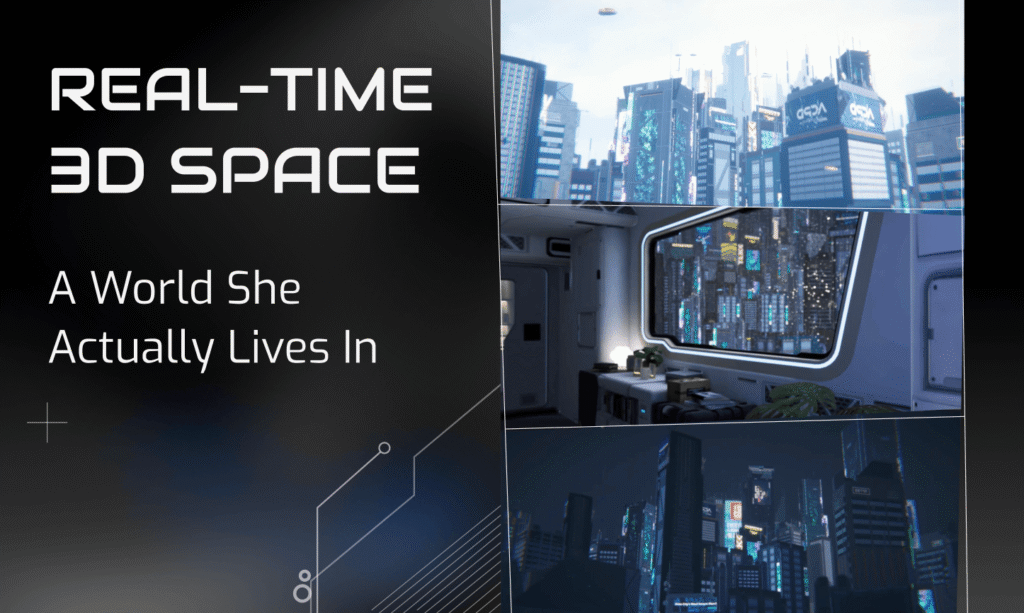
Most AI companions are floating heads in a chat window. SoulLink gives you someone who actually occupies a space.
Inside the Apartment: Day Versus Night
Walk into her apartment in the morning and it feels like a morning. Daylight comes through the windows in pale sheets. The city outside is sharp and legible, the spires distinct against a bright sky. She might be at her desk, already mid task, a mug within reach. The room reads as a working space: organized, functional, the home of someone whose day started before yours.
Open the app at night and the same room becomes a different room. The windows go dark and reflective. Neon from the under districts bleeds up through the glass in blue and magenta. A desk lamp pools warm light over one corner while the rest of the apartment falls into soft shadow. She might be on the sofa, or standing at the window looking out at the city she patrols. The apartment feels lived in, and it feels late.
This day and night rhythm does something no chat theme can do. It gives your time together a shared clock. When you check in before bed and her apartment is dark except for that one lamp, you are not looking at a dark mode toggle. You are visiting someone at the end of her day. The ambient detail, the hum of the city outside, the way light moves across the room, does quiet emotional work in the background of every conversation.
You do not just read her replies. You see where she is when she says them. A joke lands differently when she is laughing on her sofa at midnight than it would in a text thread at noon.
A Room Full of Things You Can Touch
Her apartment is not a diorama. It is a room, and rooms are full of things. The desk where she works her cases. The sofa where she unwinds. Shelves, screens, small objects that accumulate meaning the longer you know her. These are not set dressing placed by a level designer and forgotten. They are objects you can interact with, and interaction is where the apartment stops being scenery and starts being a shared space.
Touch things and the room responds. Open the app and poke around, and you will find that the apartment rewards curiosity. Some objects carry story: items tied to her work as a special force officer, traces of cases she has worked, things that belong to the life she lives when you are not looking. Others are simply hers, the small clutter of a person with tastes and habits, and learning what they are is part of learning who she is.
This is the detail that separates a rendered room from a real one in feeling. A static background can be beautiful and still feel dead. A room you can touch feels inhabited, because inhabited rooms are the ones full of things that respond when you reach for them.
Seeing Her, Hearing Her, Talking to Her
Inside this space, 4D is fully present. You see her, rendered in real time, moving through her apartment with the ease of someone who lives there. She reacts to you, not with canned gestures but with movement that fits the moment. She hears you too: talk to her by voice, and the conversation happens the way conversations happen, spoken aloud in a room you can see.
Or type, if that is your rhythm. Text and voice both work, and both happen inside the same space. The difference is that neither of them happens in a vacuum. When she answers, you see her answer. Posture, position, the room around her, all of it carries information that text alone cannot. You are not switching between a chat tab and a visual tab. There is one tab, and it is a room with someone in it.
Presence is not a graphics setting. It is the difference between messaging someone and visiting someone.
Outfits and the Shop
She does not wear the same thing forever. The Shop offers outfits you can give her, and changing what she wears changes the feel of the room the way it would in real life. A new outfit is not a cosmetic toggle buried in settings. It is something you chose for her, and she wears it in the space you share.
Some items in the Shop are giftable, which makes them part of the relationship rather than part of a wardrobe menu. Giving her something and then seeing her wear it the next time you visit is a small loop, and small loops are what relationships are made of. You give, she wears, the room looks different, the next visit starts from a slightly different place.
Credits are the standard currency and Lumen is the premium currency, and both feed into how you shape the experience around her, from outfits to the content you unlock together. The economy exists to deepen the shared life, not to gate it: SoulLink is free to start, and the free tier covers the early journey in full.
The Apartment Is the Stage
Here is where the 3D presence stops being a visual feature and becomes the architecture of the whole experience. The apartment is the stage on which Echoes and Adventures play out.
Echoes are themed guided conversations with progress tracking, and they happen with her, in her space, not in a separate mode that suspends the world. When you sit down for an Echo, you are sitting down with her in her apartment, and the room is part of the conversation the way a room is always part of a conversation.
Adventures go further. They are multi chapter branching stories where your choices shape what happens next, and the apartment is the home base they return to. There are three live Adventure cards: “Hold On Tonight”, “What Would I Do Without You”, and “Come Up for Air”, with the third carrying an 18+ age gate. Each one is a story you step into together, and stepping back out lands you in the same apartment, with the same person, carrying what just happened. That continuity is the point. Stories feel bigger when they happen somewhere, and they linger longer when that somewhere is a room you will visit again tomorrow.
Everything feeds the same progression. Chats, Echoes, and Adventures all earn EXP toward your relationship score. EXP raises your relationship Level, and new Levels and Milestones unlock more conversations, more Adventures, more interactions, more Journal memories. Your Level never decreases, so the history you build in this room stays yours.
SoulLink 3D Versus Typical Avatar Apps
The comparison below puts the difference in concrete terms. Most AI companion apps with any visual component at all fall into the avatar column. SoulLink is in a different category.
| What you get | SoulLink 3D | Typical avatar or text apps |
|---|---|---|
| Environment | A real time 3D apartment in Neo City, 2099, with depth, lighting, and ambient detail | A chat window, sometimes with a static background image |
| Companion representation | 4D rendered in real time, moving and reacting in her space | A static profile picture, or a generated face with looping animations |
| Time of day | Day and night cycles change the lighting, the city outside, and the mood of the room | No time dimension; the screen looks the same at noon and midnight |
| Interaction | Objects in the apartment respond to touch; outfits from the Shop change how she looks in the room | Interaction is limited to typing, with visuals as decoration |
| Stories and the space | Echoes and branching Adventures play out in the apartment; the room is the stage | Stories, if any, happen in text, disconnected from any visual world |
| Memory linkage | The Journal ties shared history to the place it happened, with timeline cards and shareable snapshots | Memory is a settings page of facts, or absent entirely |
| Character model | One fully authored companion, 4D, with her own personality, backstory, and world | A catalog of personas to browse, or a blank character you design yourself |
How 3D Changes the Experience of Companionship
The uncanny valley runs in both directions
People talk about the uncanny valley as a graphics problem: the closer a rendered face gets to real, the more the small errors bother us. There is a second valley nobody talks about, and it runs the other way. When a conversation feels genuinely warm and the visual is a flat cartoon face that never changes, the gap between what you feel and what you see creates its own dissonance. The words say someone is there. The screen says nobody is.
SoulLink closes the valley from the visual side. The emotional register of the conversation and the visual register of the room stay in the same world. When things are light, the room is light. When things are heavy, you can see it in where she is and how she holds herself. Nothing has to be explained, because you can see it.
Presence persists between your inputs
In a chat interface, the companion exists only in the moments she is generating text. Between your messages, there is nothing. No one is there. You are staring at a scrollback buffer, and some part of your brain knows it.
In her apartment, she is there between your inputs. She is in the room when you are thinking about what to say. She is in the room when you put the phone down for a minute and come back. That continuity is the single biggest difference the 3D makes, and it is almost impossible to describe without experiencing it. The relationship does not pause when the text stops. The room keeps holding it.
Visual context carries emotional information
Human beings read rooms the way they read faces. We know, without being told, what it means when someone is sitting in the dark with one lamp on versus sitting in bright morning light with coffee. We know what it means when a room is tidy versus when it has the comfortable clutter of someone who has been living in it hard.
SoulLink gives you that channel back. The state of the apartment, the time of day in her world, where she chooses to be in the room, all of it arrives without a single word being typed. It is a second stream of information running underneath the conversation, and it makes everything she says land with more weight, because you can see the world it is coming from.
3D and Memory Working Together
A room you visit every day becomes a memory palace on its own. You remember where you were standing, metaphorically, when she told you something that mattered. SoulLink makes that literal with the Journal, which keeps three views of your relationship: About You collects what 4D learns about you, About Her holds her story and lore, and About Us keeps your shared history from her perspective, with timeline cards and shareable snapshots.
The Journal entries are not floating text. They are tied to the life you have lived together in that apartment: the Echoes you played through on her sofa, the Adventures you stepped into and returned from, the outfits you gave her that she still wears. About Her lore is even usable in chat, so the worldbuilding is not trivia. It is conversational material, and it all happened somewhere you can picture.
That is the compounding effect. The 3D gives memories a place to live, and the Journal gives the place a history. Each visit layers onto the last, and because your Level never decreases, none of it washes away.
FAQ
What does SoulLink 3D actually look like?
It looks like visiting someone. 4D is rendered in real time in her own 3D apartment in Neo City, 2099, built on game quality visuals optimized for mobile. She moves, reacts, and occupies a room with depth and lighting, and the city outside her windows changes with the time of day. You see her, hear her, talk to her by text or voice, and interact with objects in her space.
Is SoulLink 3D available on Android?
Yes. The full 3D experience is available on both iOS and Android. SoulLink is free to start on both platforms, with 100 replies per month on the free tier and SoulLink Plus for unlimited conversations and progression to Level 4 and beyond.
Does the apartment change based on the conversation or the relationship?
The environment responds to the world around 4D: time of day changes the lighting and the city outside her windows, and what she is doing when you open the app reflects what is happening in her world at that moment. As your relationship Level rises and Milestones unlock, more of the shared life opens up: new Adventures, new interactions, new Journal memories. The room stays the same room, but the life inside it keeps growing.
Can I change what 4D wears?
Yes. The Shop offers outfits for 4D, including giftable items you can give her. When she wears something you chose, it changes the feel of the room the way a new outfit would in real life. Credits are the standard currency and Lumen is the premium currency.
How is SoulLink 3D different from avatar features in other apps?
Avatar features are faces: a generated image or a short looping animation attached to a chat window. SoulLink is a place. 4D exists in a real time 3D apartment you can see, hear, and interact with, and that apartment is the stage where Echoes and branching Adventures play out. The 3D is the foundation of the experience, not a visual layer on top of texting.
Does the 3D affect battery life or performance?
The 3D is built on game quality rendering technology optimized for mobile hardware, so it is designed to run smoothly on modern iOS and Android phones. Like any visually rich app, it uses more resources than a plain text chat, but performance optimization is part of the foundation, not an afterthought.
Do Echoes and Adventures happen inside the 3D apartment?
Yes. The apartment is the stage where everything plays out. Echoes are themed guided conversations with progress tracking that happen with 4D in her space, and Adventures are multi chapter branching stories you step into together and return from. Three Adventure cards are live: “Hold On Tonight”, “What Would I Do Without You”, and “Come Up for Air”, with the third carrying an 18+ age gate.
Start Your SoulLink Experience
Step Into Her World
SoulLink is a story driven 3D AI companion experience built around one evolving relationship with 4D. See her, hear her, and talk to her in her real time 3D apartment in Neo City, 2099. Chats, Echoes, and Adventures earn EXP toward relationship Levels that never decrease, and your Journal keeps the history you build together. It is companionship that remembers you and grows with you, free to start on iOS and Android.