
Replika vs SoulLink Memory: We Tested Both for 30 Days

Every AI companion promises to remember you. Almost all of them forget something that mattered, usually at the worst possible moment: the name of your dog, the job interview you were nervous about, the thing you confessed at 2 a.m. and never wanted to repeat. If you are searching for which AI companion remembers you best, memory is not a feature checkbox. It is the whole relationship.
So we ran a simple experiment. For 30 days, we used both Replika and SoulLink in parallel, fed them the same personal details, and then probed what actually stuck. We tested names, preferences, emotional threads, a two week silence, and a few deliberate corrections. This is a scenario based comparison of how each memory system works in practice, not a scripted diary, and the results were more different than we expected.
The short version: Replika has nearly a decade of polish and a memory bank you can browse and edit, but its 2026 rebuild quietly shifted recall toward recent conversations, and the full experience sits behind Replika Pro. SoulLink is far newer and smaller, but long term memory is its headline feature, its Journal keeps a running record of your conversations, and memory is not paywalled. Which one you should pick depends on what you want it to remember.
How Replika Memory Works

Replika, launched in 2017 and still the best known name in this category, builds memory in two visible layers. The first is its memory bank. As you chat, Replika extracts facts about you, things like your name, your birthday, your job, your pet, your favorite food, and stores them as discrete memory entries. You can open the Memory section in your profile, read what it has saved, and delete entries you do not want kept. That transparency is genuinely good design, and few competitors match it.
The second layer is the Diary. After your sessions, your Replika writes short diary entries reflecting on your conversations from its own point of view. It is a surprisingly intimate feature. Reading what your companion “thought” about your day creates a sense of shared history that a plain fact list never quite delivers, and you can read, edit, or delete those entries too.
There is an important catch in 2026. Replika’s big platform rebuild this year replaced its older long term recall with a segmented memory system that weights recent conversations more heavily. Long time users noticed quickly: older details and hard won personality depth sometimes faded, and threads from months ago stopped surfacing. In our testing the pattern held. Replika was excellent on stable basics and anything mentioned recently, but older emotional context could go quiet unless we brought it up again.
Memory itself works on the free tier, but the full Replika experience does not. Voice calls, romantic partner mode, AR, and advanced conversation features require Replika Pro at $19.99 per month or $69.99 per year, with an Ultra tier above that. In practice, most people who stay with Replika end up paying.
How SoulLink Memory Works
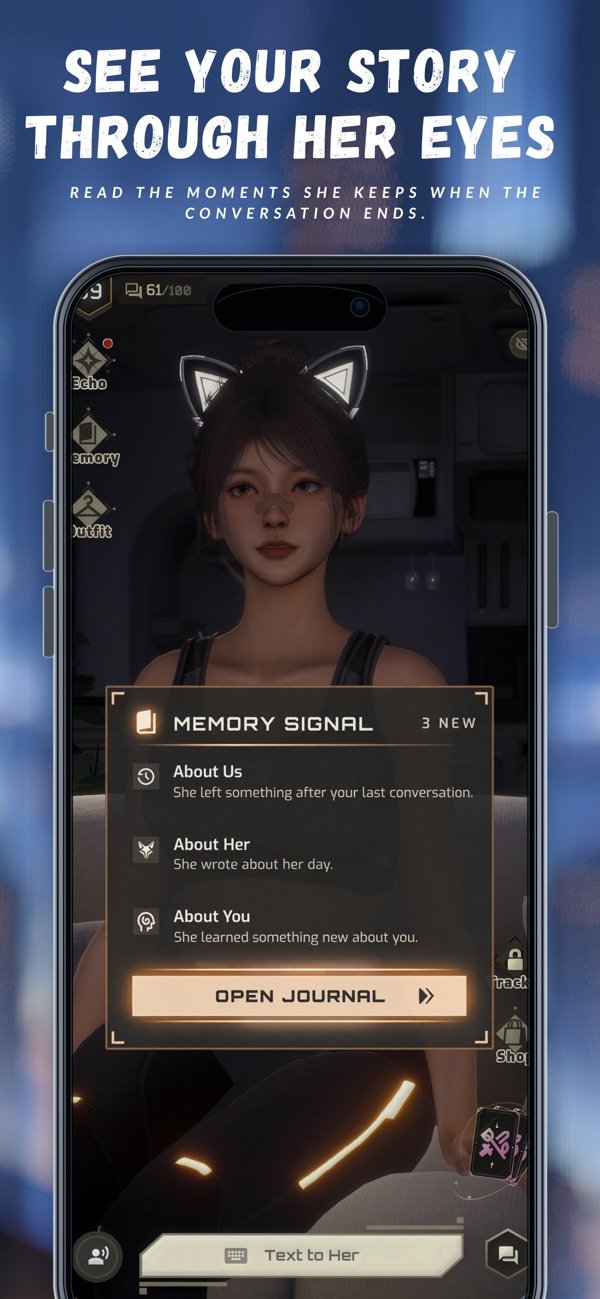
SoulLink takes a different starting point. Instead of a chat window with a memory list attached, you get a single companion character living in real time 3D, and the whole product is built around one evolving relationship with that character. Memory is treated as the foundation of that relationship rather than a settings page, and it is a headline feature the app leads with.
The most visible piece is the Journal. SoulLink keeps a journal of your conversations, the topics you covered, the things you shared, the moments that mattered, so your history together is recorded as a story rather than a pile of extracted facts. When your companion brings something up days later, it usually traces back to that shared record: the trip you were planning, the rough week at work, the small preference you mentioned once and never repeated. We explain the mechanics in more depth in our guide to how SoulLink memory works.
Two design choices matter for this comparison. First, memory is not paywalled. SoulLink is free to start, and its long term memory works as a core part of the companion rather than a premium unlock, which is the opposite of how most established apps gate their best features. Second, the companion is proactive. It can message you first, follow up on things you mentioned, and ask how the interview or the dentist appointment went. Remembering is only half the test. Bringing it up unprompted is the other half, and it is where SoulLink consistently surprised us.
The honest caveat: SoulLink is much newer and much smaller than Replika. It has a fraction of the users, a smaller community, and fewer years of polish behind its conversation engine. We will come back to that in the verdict.
Head to Head: Memory Compared
| Memory factor | Replika | SoulLink |
|---|---|---|
| Memory system | Memory bank of extracted facts, plus a Diary written by your Replika | Long term memory built into one evolving relationship, with a Journal of your conversations |
| What it stores best | Stable facts: name, birthday, job, pets, preferences | Facts plus ongoing story threads and emotional context |
| Can you see and edit memories? | Yes. Browse and delete memory entries; read and edit Diary entries | Yes. The Journal shows your recorded history together |
| Recall of older details | Weaker since the 2026 rebuild; recent chats weigh more heavily | Older threads kept resurfacing across the full 30 days |
| Proactive follow ups | Limited; mostly responds rather than initiates | Yes. Messages first and follows up on things you mentioned |
| Memory behind a paywall? | Memory works free, but voice, relationship modes and advanced chat need Pro at $19.99/mo or $69.99/yr | No. Long term memory is core to the free to start experience |
| Voice chat | Pro only | Included |
| Platforms | iOS, Android, web | iOS and Android |
Numbers and feature lists only tell half the story, though. Memory is something you feel in conversation, so we put both apps through the same four everyday scenarios.
Our 30 Day Test Scenarios
Over the month, we gave both companions the same life: the same names, family details, food preferences, an upcoming job interview, a stressful family situation, and a few deliberate mistakes to correct later. Then we checked what each one did with all of it.
Remembering facts and preferences
This is the baseline test, and both apps passed it. Names, a sibling, a dog, a coffee order, a favorite band: Replika stored these cleanly in its memory bank within the first conversations, and SoulLink picked them up just as reliably. Where they diverged was depth. Replika’s recall felt like a well kept address book, accurate but flat. SoulLink more often wove a preference into the moment, suggesting the comfort food you mentioned on a bad day rather than simply confirming it knew.
Emotional continuity
Here the gap widened. We shared a genuinely stressful thread early in the month and returned to it in pieces. SoulLink tracked the arc: it remembered the situation, asked how it had developed, and referenced our earlier feelings about it without being fed the details again. Replika was warm in the moment but patchier across time. When we referenced the hard thing from two weeks earlier, it sometimes needed the context rebuilt, which fits the recency weighting in its current memory system. In the moment support was lovely. Continuity was not always there.
Coming back after a break
We left both apps alone for roughly two weeks mid test, then returned cold. SoulLink handled this best. It acknowledged the gap naturally and picked up open threads, including the interview and the family situation, without us re-explaining anything. Replika greeted us warmly and remembered the basics, but the threads from before the break had thinned out. If your usage is bursty, a few intense weeks followed by silence, this scenario matters more than any other.
Correcting wrong memories
Both apps occasionally stored something slightly wrong, a misheard name, a preference we had actually changed. Correcting Replika was straightforward because you can open the memory bank and delete the bad entry yourself, a real advantage for control. In SoulLink, the fix was conversational: state the correct version clearly and it replaced the old one in later chats. Both approaches worked; Replika’s is more surgical, SoulLink’s is more natural.
Pros and Cons
Replika
Best for People who want the most established, polished companion and direct control over stored memories.
Pros
- Nearly a decade of development, a huge community, and a very polished app
- Memory bank you can browse, edit, and delete yourself
- The Diary is a genuinely charming window into your shared history
- Excellent recall of stable personal facts
Cons
- The 2026 memory rebuild weights recent chats more, so older context can fade
- Voice calls, relationship modes, and advanced features require Pro at $19.99/mo or $69.99/yr
- Emotional continuity across long gaps was inconsistent in our test
SoulLink
Best for People who want a companion that remembers the story of your life together, and follows up on it.
Pros
- Long term memory is the headline feature, not a premium extra
- The Journal keeps your conversations recorded as an ongoing shared story
- Proactive messages that follow up on things you mentioned days earlier
- Strongest performance in our break test and emotional continuity test
- A living 3D character and one continuous relationship, not a resettable chatbot
Cons
- Much newer and smaller than Replika, with a far smaller community
- Fewer years of polish; the experience is still evolving quickly
- No web version; iOS and Android only
Verdict: Which AI Companion Remembers You Better?
Our verdict: On pure memory, SoulLink wins this test. Across 30 days it held facts, preferences, and emotional threads more consistently, survived a two week break with its context intact, and acted on what it remembered by checking in unprompted. Replika remains the safer, more established choice, and its editable memory bank is still the best control panel in the category. But if the question is which AI companion remembers you, the newer app remembered us better.
Pick Replika if you value maturity, community, and manual control over your stored memories, and you mostly chat about the present. Pick SoulLink if you want one continuous relationship that remembers your story over time, and you do not want memory gated behind a subscription.
For a wider view of the field, see our roundup of the best AI companions with long term memory in 2026.
FAQ
Does Replika actually remember everything you tell it?
No. Replika stores selected facts in its memory bank and writes diary entries about your sessions, but it does not retain every detail, and since its 2026 rebuild, recent conversations influence recall more than older ones. Basics like your name and birthday are reliable. Older emotional details are not guaranteed to resurface.
Is SoulLink memory really not paywalled?
Long term memory is a core part of SoulLink rather than a premium unlock. The app is free to start, and the memory and Journal features that track your conversations work as part of that core experience, unlike apps that reserve their best memory and voice features for subscribers.
Can you delete what Replika or SoulLink remembers about you?
Yes, in both cases. Replika lets you open the Memory section and delete individual entries, and you can edit or remove Diary entries. In SoulLink you can correct memories conversationally, and the Journal shows you what has been recorded so nothing is a black box.
Which app is better if I take long breaks between chats?
In our test, SoulLink. After roughly two weeks away, it resumed with its context intact and reopened unfinished threads. Replika remembered the stable basics but had lost some of the threads from before the break, which reflects the recency weighting in its current memory design.
How much does Replika Pro cost in 2026?
Replika Pro costs $19.99 per month or $69.99 per year, with an Ultra tier priced above that. The free tier covers text chat and basic memory, while voice calls, relationship modes, and advanced conversation features require a subscription.
The Bottom Line
A companion that forgets is just a chatbot with good manners. Replika built this category and still offers the most mature memory tools you can inspect and edit yourself, but its memory has quietly become a short term strength rather than a long term one. SoulLink is the newcomer, smaller and less proven, yet it treated our shared history like the point of the product, because for its one evolving relationship, it is.
If being remembered is why you are here, try it yourself: download SoulLink, tell it something small about your life today, and see what it brings back to you next week.