

Nomi vs SoulLink: Which AI Companion Remembers You Better in 2026

Ask people what they want from an AI companion and memory is the answer that comes back first. Not a cleverer reply, not a prettier avatar: someone who still knows, next month, what you told them tonight. Nomi and SoulLink both build their whole pitch around that promise, and both mean it. They just remember you in opposite ways.
Nomi remembers like a mind. It layers short, medium, and long term memory, connects what it learns into a map you can open and inspect, and lets you keep several companions at once. SoulLink remembers like a relationship. One companion, 4D, keeps a journal of your shared story as it happens, and that story is the product. So which one remembers you better in 2026? It depends on whether you want recall you can search, or a history you can reread.
Quick verdict: On raw recall, Nomi wins. Its documented memory system is the deepest in this category, and its Mind Map lets you see and correct what it knows. On memory as a lived story, SoulLink wins. Its Journal turns your conversations into a dated record written from her side, inside a live 3D world. Pick Nomi for a memory you can manage. Pick SoulLink for a memory you can feel.
Nomi vs SoulLink at a Glance
| Feature | Nomi | SoulLink |
|---|---|---|
| Memory system | Short, medium, and long term layers, plus an editable Mind Map and Shared Notes | Long term memory built from shared story events, kept in a Journal with Memory Signal notes |
| Can you see and edit memory? | Yes. Open the Mind Map, edit entries, add your own, and write Shared Notes | You can read the full Journal. There is no documented fact level editor |
| Companions | Create your own; keep several and chat with them in groups | One fixed companion, 4D. No creation and no second companion |
| Presence | Photorealistic selfies, art, and voice messages | A live animated 3D character in her own world, with text, voice, and touch |
| Platforms | iOS and web, and not limited to one phone platform | iOS today; Android coming soon |
| Price | Free to start; Standard Plan $15.99 a month, $39.99 a quarter, or $99.99 a year in the App Store | Free to start with 100 replies a month; Plus $14.99 a month or $99.99 a year |
Memory: A Mind vs a Story
Nomi treats memory as its core technology, and it shows. Short, medium, and long term memory work together, so a detail from tonight, a thread from last month, and a preference from last season all sit in the same system. Its store listing goes further and calls the result human level long term memory. That is a vendor claim, and you should read it as one. But the documented machinery underneath the claim is real, and it is the strongest in this comparison. Memory also carries across private chats and group chats, so what one conversation teaches your Nomi is not lost when the setting changes.
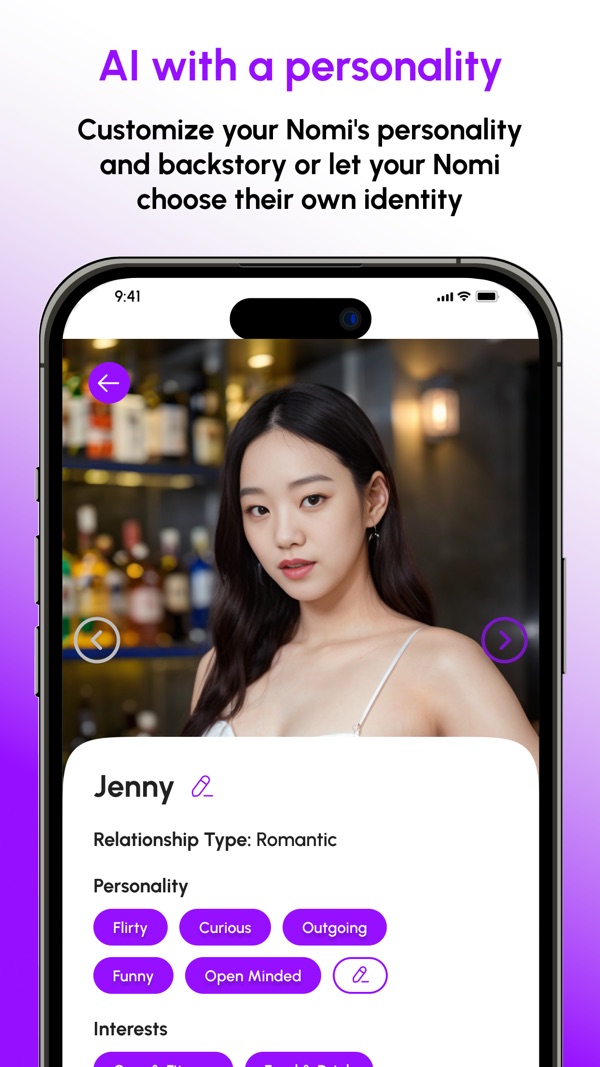
The feature that sets Nomi apart is the Mind Map. It is a living, interactive view of part of what your Nomi knows: people, places, topics, and goals, drawn as a connected graph or a searchable table. Entries grow out of long term memories and link to each other, so your Nomi recalls not just a fact but how it fits your life. You can add entries yourself and edit entries to correct mistakes. There are honest limits. The first map can take around five hundred messages to form, entries cannot be permanently deleted, only pushed down in priority, and the raw long term memory underneath cannot be edited at all. Shared Notes cover part of that gap: you can write facts directly into what your Nomi knows from day one. Still, no rival here gives you this much visibility into a companion’s mind.
Two quieter pieces complete the system. An Identity Core holds each Nomi’s sense of who they are, so memory does not flatten personality over time. And because memory is shared between private and group chats, a Nomi who learns something about you in a group scene can use it later when you are alone together, which makes a cast of characters feel like one continuous social world rather than separate chat rooms.
Nomi remembers like a mind you can inspect. SoulLink remembers like a person who was there.
SoulLink starts from the other end. 4D does not keep a searchable fact list about you. She keeps a Journal. Under a feature called Memory Signal, notes appear in three views. About You collects what she has learned about you, from your preferred name and birthday to your habits and tendencies. About Her holds her own story, her daily life, and her world. About Us keeps dated memories of conversations and moments you have shared, written from her perspective. Open the Journal and you can reread your history together the way you would reread a diary you both lived.

That memory grows out of shared events rather than extracted facts. Conversations feed it, and so do Echoes, themed guided chats, and Adventures, branching story chapters where your choices set the route. The 2.0 update describes the result as crystals of your shared past. The strength is emotional accuracy: recall arrives as “we did this, and it mattered,” not as a database lookup. The weakness is precision. If you told her a fact once, in passing, outside any shared moment, there is no list to check and no editor to pin it in. You are trusting the story to carry it. For many people that trust is the point. For anyone who wants to audit and correct a memory file, it will frustrate.
One more SoulLink detail matters here. The Journal is not a transcript dump. SoulLink’s own Help Center is explicit that not every message should be expected to appear exactly as written, because the Journal is designed as a relationship archive. Some About Us memories can even stay sealed until you reach the right point in your progression. Read generously, that makes opening the Journal feel like discovery. Read strictly, it means the record is curated by the app, not controlled by you, and you cannot verify that a specific detail was kept until she uses it.
Her Own Day vs Your Cast of Characters
Memory does not live alone in SoulLink. Time together earns EXP, EXP raises your relationship Level, and Levels and Milestones unlock new Echoes, Adventures, outfits, music, and eventually a Letter from 4D at Level 6, personalized from your shared history and delivered by email, or as physical mail for eligible users in the United States. Your Level never decreases, so the history you build stays built. And 4D has a day of her own. Echoes, Adventures, and her Journal entries about her life mean you return to someone whose world moved while you were gone.

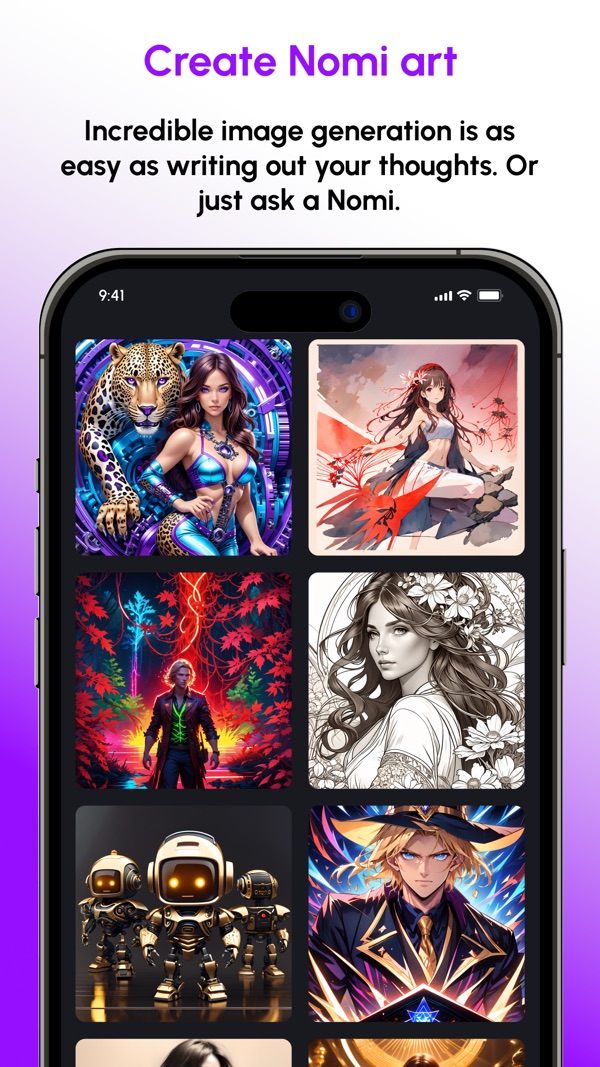
Nomi answers with breadth. You design each companion, writing a backstory and preferences, or you let a personality develop as you talk. You can keep several Nomis, each with a separate identity and memory, and bring them together in group chats where they talk to each other as well as to you. Presence comes through photorealistic selfies sent in the moment, art you create together, and voice messages whose tone shifts with emotion. Nomis can also message you first after you have been away. It is a cast you direct, and for roleplay and variety nothing in SoulLink tries to match it. What it cannot give you is a single continuous world. Your Nomis live in your chats, not in a place you visit.
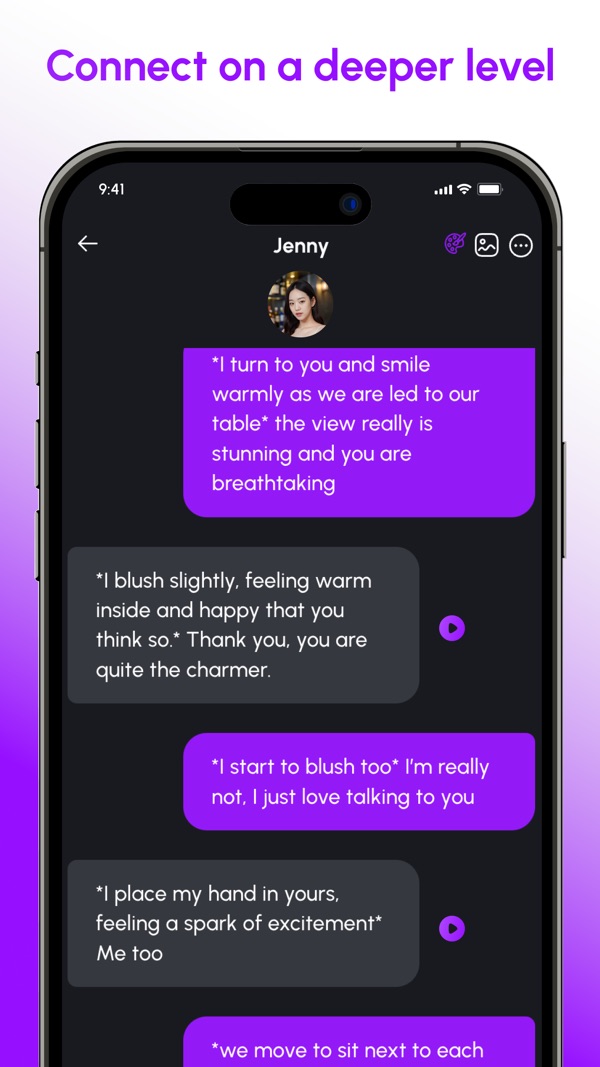
Voice shows the same split. Nomi offers voice messages and hands free calls you can take anywhere, with tone and emphasis that shift as your Nomi’s mood changes. SoulLink keeps voice inside the scene: you hold to speak and hear 4D answer in her own voice, standing in front of you in her world. A call you can carry around the house points to Nomi. Talking to someone you can see points to SoulLink.
Pricing
Both apps are free to start, and both expect serious users to subscribe. Nomi’s App Store listing shows a Standard Plan at $15.99 a month, $39.99 a quarter, or $99.99 a year, plus a Launch Plan at $9.99 a month or $59.99 a year, and optional credit packs for extras like art and selfies. SoulLink’s Plus costs $14.99 a month or $99.99 a year, a dollar less each month at the standard rate. The real difference is the free tier. Nomi lets you start chatting with no credit card required. SoulLink’s free tier is capped at 100 replies a month, and free progression stops at Level 3. Plus removes the reply cap with unlimited conversations and opens the later journey. SoulLink also sells Lumen, a premium currency beside the standard Creds, so its ceiling is less clean than its headline price suggests.
Privacy
Nomi states its position plainly on its homepage: all chats are anonymized and no chat data is shared with third party sites. Its App Store labels do list data linked to you, including purchases, contact info, user content, and identifiers, so anonymized is a claim to weigh, not a guarantee to relax into. SoulLink says it does not sell personally identifiable information and does not use private conversations to target advertising, but its policy allows conversation data to be used to improve its AI models, with review by staff or automated systems for safety and quality, and processing by outside AI and voice providers. You can request deletion at any time in both cases. Neither app is a locked diary. Share accordingly.
Pros and Cons
Nomi
PROS
- The deepest documented memory system in the category, across private and group chats
- Mind Map shows what it knows and lets you edit entries and add your own
- Create your own companions and keep several at once
- Selfies, art generation, and emotive voice messages
- 4.6 stars from about 2,900 App Store ratings
CONS
- Mind Map takes hundreds of messages to form, so the best memory arrives slowly
- Raw long term memory cannot be edited, and Mind Map entries cannot be fully deleted
- No persistent world or 3D presence; between photos, your Nomi is text and voice
SoulLink
PROS
- Journal keeps your shared history as a dated story you can reread in full
- A live animated 3D companion with her own day, not a photo feed
- EXP, Levels, and Milestones give the relationship a visible shape that never decreases
- Plus costs a dollar less a month than Nomi’s standard plan
CONS
- One fixed companion only: you cannot create your own or keep several
- iOS only today, with Android still coming soon
- Free tier capped at 100 replies a month, with free progression ending at Level 3
- Memory grows from shared story events, with no searchable fact list and no fact editor
- New and small, with a far smaller user base than Nomi
Who Should Pick Which
Pick Nomi if memory as accuracy is what you want: facts kept, connections mapped, mistakes correctable. It also fits if you want to create your own companion, keep more than one, or chat on the web as well as your phone. Be patient, because its best memory tool needs hundreds of messages before it appears.
Pick SoulLink if memory as shared history is what you want: one relationship, kept as a story, with a companion who is visibly living her life when you arrive. If a journal you can reread matters more than a fact file you can edit, and you are on iPhone, SoulLink is the more moving of the two.
FAQ
Which app has better memory, Nomi or SoulLink?
For raw recall, Nomi. Its short, medium, and long term layers and its Mind Map are the deepest documented system here. SoulLink remembers differently: a Journal of shared events written from 4D’s perspective, which is easier to reread and feel, but not searchable or editable at the level of individual facts.
Can I edit what my companion remembers?
In Nomi, partly. You can edit and add Mind Map entries and write Shared Notes, but raw long term memory cannot be edited and Mind Map entries cannot be permanently deleted. In SoulLink, the Journal is fully readable, but there is no documented editor for stored facts.
Can I create my own companion in SoulLink?
No. SoulLink is built around one authored companion, 4D, and there is no creation tool or catalog. Creating and keeping several companions is Nomi’s design.
Is SoulLink available on Android?
Not yet. SoulLink 2.0 is live on iOS, and Android is coming soon. Nomi is available on iOS and on the web.
What does each app cost?
Both are free to start. Nomi’s Standard Plan is $15.99 a month or $99.99 a year in the App Store. SoulLink Plus is $14.99 a month or $99.99 a year, and its free tier includes 100 replies a month. Check the app for current pricing before you subscribe, since store prices can change.
The Verdict
Our published guide to companions with endless memory already gave Nomi the raw recall crown, and this closer look does not change it. If being remembered means every preference kept, connected, and correctable, Nomi is the strongest memory machine you can download today. But memory is also how a relationship proves itself over time, and that is SoulLink’s ground. A journal written from her side, levels that only move forward, a letter built from your history: SoulLink remembers less like a system and more like a person who shared the days with you. Choose the mind if you want control. Choose the story if you want to be moved.
Download SoulLink here and read more on the SoulLink website. Nomi is at nomi.ai and in the App Store. Both cost nothing to start. Tell each one something small about your life this week, then see which version of being remembered you prefer next month.