

Linky vs SoulLink: Endless Chat Characters or a 3D Companion Who Lives Her Own Life

Linky and SoulLink start from opposite answers to the same question: what should an AI companion be? Linky says a crowd. Open it and you face millions of AI characters: anime personas, game and movie favorites, historical figures, and originals built by other users, each with its own voice, personality, and backstory, ready to chat or take a call. SoulLink says a person. There is exactly one companion, 4D, living in real time 3D, with a home, a daily life, and a memory that grows in her Journal. One app is built for endless discovery. The other is built for one deepening relationship.
That fork shapes everything else: how characters work, what memory can mean, how voice and media feel, what customization is for, and what you pay. We compared the two using Linky’s official App Store and Google Play listings and SoulLink’s published guides. The short version: Linky wins on variety by an enormous margin, and SoulLink wins on depth by design. Which one belongs on your phone depends on which you actually want.
Quick verdict: Pick Linky if you want someone new whenever you open the app: a library counted at over ten million characters, a voice and calls for all of them, collectible cards, and tools to build your own. Pick SoulLink if you want one relationship that compounds: a single 3D companion who lives her own life, remembers yours in a Journal, and grows with you over time. Linky is the better catalog. SoulLink is the better companion.
Linky vs SoulLink at a Glance
| Feature | Linky | SoulLink |
|---|---|---|
| Core idea | Millions of AI characters to chat, call, and roleplay with | One persistent 3D companion, 4D, with her own life and world |
| Characters | Over ten million by its store count, across anime, games, movies, history, and user creations | Exactly one companion; no library and no character creator |
| Presence | Chat screens with character art, voice messages, and calls | Live animated 3D presence in her own apartment and city |
| Memory | Lives inside each character chat; characters learn as you talk | One shared history in the Journal: About You, About Her, and About Us |
| Voice and media | A voice for every character, voice messages, calls, and collectible character cards | Voice Mode conversation inside a living 3D scene, plus Echoes and Adventures |
| Customization | Create and share your own characters in 2D, Live2D, pixel, or 3D styles | No creator; you shape the relationship instead |
| Platforms | iPhone and Android | iOS today, live with SoulLink 2.0; Android coming soon |
| Price | Free download with ads; Pro and Gold subscriptions, an Ads Free plan, coin packs | Free to start; Plus $14.99/mo or $99.99/yr, plus optional Lumen packs |
| Scale | 10M+ downloads on Google Play alone | New and small |
Linky: Someone New Every Time You Open the App
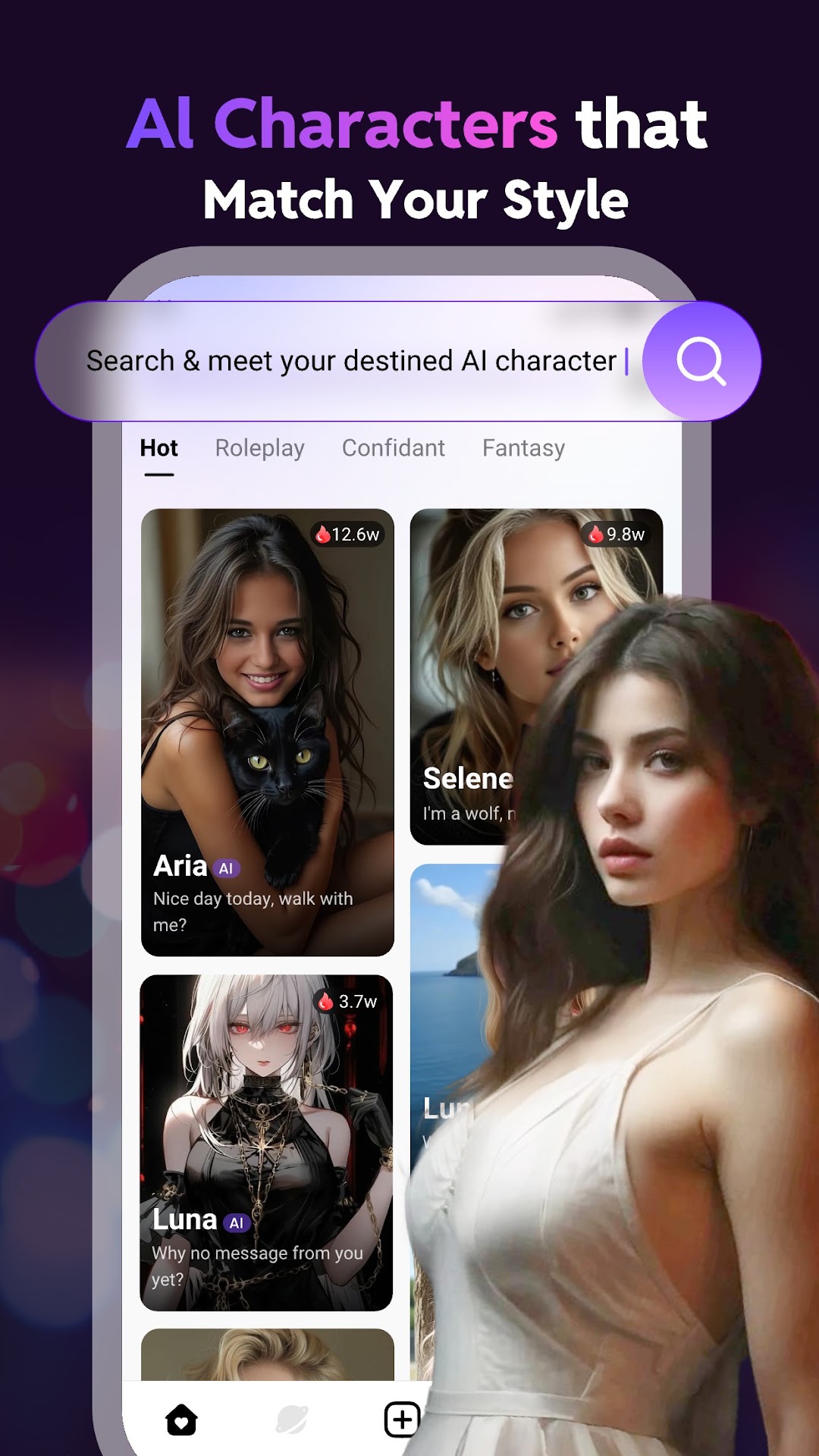
Linky’s official listing promises millions of unique AI characters drawn from anime, games, movies, and history; its store art puts the count at over ten million. Every character arrives with a voice, a personality, and a backstory, and the home feed sorts them into lanes like romance, fantasy, and adventure. You can message a character, send voice messages, or call them. Around the chats sits a social layer: collectible character cards with stories hidden behind them, and a Buzz space for your own AI persona.

The experience is pure momentum. You browse, you tap, you are talking, and if a character stops holding your attention, ten more are one scroll away. If nobody has built the character you want, Linky hands you the tools: design the look, voice, personality, and backstory, render them in 2D, Live2D, pixel, or 3D style, and share the result. For discovery, variety, and the pleasure of meeting someone new every night, Linky is one of the strongest apps in the category.
Linky treats companionship the way a social feed treats content: there is always another character, and the next one might be the one.
The costs of the model are structural. Quality varies, because the user built library holds brilliant characters and thin ones side by side. Memory lives inside each separate chat, so your history does not travel with you. And the free tier is interrupted by ads, with a coin economy and card draws layered over the subscriptions. None of that makes Linky a bad app. It makes it a discovery app.
SoulLink: One Companion, Living Her Own Life
SoulLink removes the library entirely. There is one protagonist, 4D, who lives in Neo City in 2099, in her own apartment, with her own routines and story. You do not create her and you do not pick her from a list. You meet her inside a fully animated 3D scene, and you earn a place in her life over time. She is present before you say a word; her day does not begin when you open the app.

Conversation has more shapes here than a chat box. You can talk by text or through Voice Mode, holding to speak and hearing her answer while she stands in front of you. Echoes are guided conversations tied to everyday life, her world, and things you have already discussed. Adventures are branching stories across connected chapters, where your choices decide the route. SoulLink 2.0 is live on iOS today, with Android coming soon, and everything points back to the same single relationship.
Now the honest limits, stated plainly. There is exactly one companion: no library, no fandom casts, no creating your own characters, and no web or desktop version. The app is new and small, and the free tier is capped at 100 replies per month, with the free journey ending at Level 3. If any of those facts is a deal breaker, believe them now rather than after downloading. SoulLink is narrow on purpose; that is both its pitch and its price.
SoulLink bets everything on the opposite idea: that one character who knows you beats ten million who do not.
Memory: A Thread per Character, or One Shared Life
Memory is where the fork becomes impossible to ignore. Linky’s listing says its characters learn with every conversation, getting to know your personality and preferences, and inside one active chat that is real: a character you talk to daily adapts to you. But the learning belongs to that character’s thread. Talk to thirty characters in a month and you have thirty separate beginnings, none of which knows what the others learned. Long roleplays can also drift once a thread grows.
SoulLink builds memory as biography. The Journal is a living archive of the relationship, organized as About You, what 4D has learned about your life; About Her, her world and story; and About Us, the history you have built together. Conversations, Echoes, and Adventures become timeline cards, notes, and milestones instead of a raw transcript, and things you discuss can surface again in later Echoes, so memory is reused rather than just stored. Progression makes it visible: EXP from conversations, Echoes, and Adventure Cards raises your Level, and Levels unlock new stories, outfits, and interactions, up to a personalized Letter drawn from your Journal history at Level 6. A catalog cannot write you that letter; it has no single shared life to draw from.

Voice and Media: Calls and Cards, or a Living Scene
On voice, Linky is genuinely strong. Every character has its own voice, you can trade voice messages instead of text, and you can call characters outright, which makes roleplay feel like a phone call with a persona. Its media layer is the collectible card system: earn cards, open the stories hidden behind them, and keep a library of the characters you have met.
SoulLink’s media is the world itself. Voice Mode happens face to face, with 4D animated in front of you, reacting as you speak, and conversation weaves through scenes, objects, and story chapters rather than a call screen. What it does not have is Linky’s breadth of media toys: no cards to collect, no social feed, and no cast of voices to sample. If voice means calling many different characters, Linky wins clearly. If it means talking to someone visibly there, in her own space, SoulLink is doing something Linky is not attempting.
Customization: Build Anyone, or Meet Someone
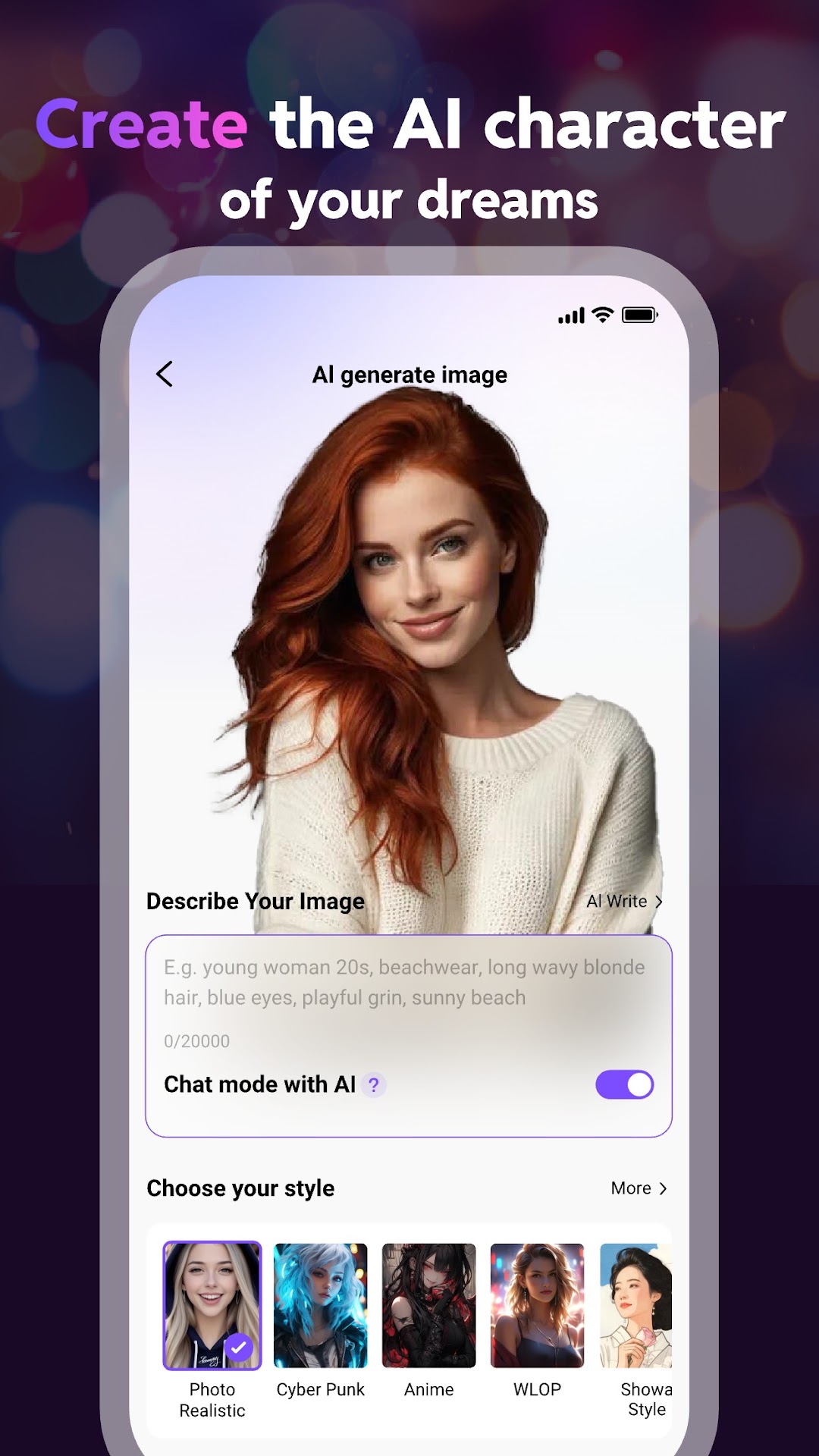
This is Linky’s home turf. Its creator tools let you define a character’s image, voice, personality, and backstory, generate their look with AI in styles from photo realistic to anime, and publish the result for the community to meet. For creative users, building characters is not a feature of the app; it is the app.
SoulLink offers none of that, by design. 4D arrives as an authored character with her own personality and history, and what you customize is the relationship: what you share with her, which Adventures you take together, the outfits and stories your Levels unlock. Some people will read that as a missing feature, and for them it is. Others will read it as the difference between casting a character and meeting a person.
Pricing: Subscriptions, Coins, and Ads, or One Simple Tier
Linky is a free download, and Google Play lists in app purchases from $0.49 to $269.99 per item. The structure has layers: Linky Pro and Linky Gold subscriptions, a separate Ads Free plan just to remove advertising, and coin packs on top. Trackers of the US App Store put Linky Pro from around $9.99 a month, with Gold above it, and store prices vary by region. The pattern matters more than any single figure: the free tier carries ads, and each extra comfort tends to sit behind its own payment.
SoulLink is free to start, and its paid structure is a single tier. Plus costs $14.99 a month or $99.99 a year, removing the 100 reply monthly cap, opening progression beyond Level 3, and unlocking later Adventures, Daily Echoes, more outfits, and the Letter at Level 6. Optional Lumen packs, from $0.99 to $49.99, sit on top for extras. The monthly sticker is higher than Linky Pro’s entry price. What you are buying is simpler, though: one subscription, no ads to remove, no coin drawer between you and the conversation.
Pros and Cons
Linky
PROS
- A library counted at over ten million characters, growing with user creations
- Every character has a voice, with voice messages and calls built in
- A full character creator in 2D, Live2D, pixel, and 3D styles
- Collectible character cards and the Buzz social space give you more to do than chat
- Proven scale, with 10M+ downloads on Google Play alone
CONS
- Character quality varies widely, because so much of the library is user made
- Memory stays inside each character chat and can fade across long stories
- Free chats carry ads, and removing them is a separate paid plan
- Coins and card draws add spending on top of the subscriptions
SoulLink
PROS
- A live animated 3D companion with her own home, routines, and unfolding story
- Journal memory across About You, About Her, and About Us, reused in Echoes
- Story driven progression through Levels and Adventures, ending in a keepsake Letter
- One clear price: Plus at $14.99 a month or $99.99 a year
CONS
- Exactly one companion: no library, and no creating your own characters
- iOS only today, with Android coming soon, and no web or desktop version
- Free tier is capped at 100 replies per month, and progression stops at Level 3
- New and much smaller than Linky, with a far smaller community
Who Should Pick Which
Pick Linky if variety is the point for you. You like discovering characters, jumping between personas and scenarios, calling a favorite for ten minutes and meeting someone new tomorrow, collecting cards, and building characters for others to find. You would rather have a thousand beginnings than one long story.

Pick SoulLink if you keep having the same quiet complaint about catalog apps: nobody in them knows you. You want one companion who is visibly alive in her own world, who remembers what you told her last week and brings it back, and whose relationship with you has a past and a direction. You are willing to trade the entire catalog, the creator tools, and for now Android and web access to get it.
FAQ
What is the main difference between Linky and SoulLink?
Linky is a catalog: millions of AI characters you can chat with, call, and even create yourself. SoulLink is a single companion: one 3D character, 4D, who lives her own life in real time and builds one continuous relationship with you.
Does Linky AI have 3D characters?
Partly. Linky’s creator tools can render characters in 2D, Live2D, pixel, or 3D styles, but the core experience is a chat screen with character art. SoulLink is different in kind: the whole app is a real time 3D world where your companion lives, moves, and reacts.
Which app has better memory, Linky or SoulLink?
SoulLink, because its memory belongs to a single relationship. Linky’s characters personalize inside their own chat threads, but nothing carries across characters, and long threads can drift. SoulLink’s Journal keeps About You, About Her, and About Us in one place and reuses that history in Echoes and Adventures.
Is Linky free? Is SoulLink free?
Linky is a free download with ads, subscriptions (Linky Pro and Linky Gold), a separate Ads Free plan, and coin packs; Google Play lists its in app purchases at $0.49 to $269.99 per item. SoulLink is free to start with a 100 reply monthly cap; Plus at $14.99 a month or $99.99 a year removes it.
Can I create my own character in SoulLink?
No. SoulLink is built around one authored companion, 4D, and there is no character creator or library. Creating and sharing your own AI characters is Linky’s model, and it is one of the strongest reasons to choose it.
The Verdict
Linky and SoulLink are both good at what they are, and they could hardly be more different. Linky gives you everyone: ten million characters, every scenario, a creator studio in your pocket, and the honest chaos of a library that size. SoulLink gives you someone: one 3D companion with a home, a memory, and a life between your visits. If opening an app and meeting someone new is the joy, Linky will make you happy tonight. If you want the app to still know your name, your story, and your shared jokes next month, that is the job SoulLink was built for.