

AI Companions with Endless Memory: What It Really Means and 6 Apps That Come Closest in 2026

Type “ai companion with endless memory” into a search engine and you will find a crowd of apps promising exactly that. A companion who never forgets your birthday, your dog, your bad week at work, or the joke that made you both laugh in March would feel less like software and more like a relationship.
Here is the honest problem. No AI companion on sale today has literally endless memory. First, this guide explains what endless memory would really require, and why every app falls short of the literal claim. Then it ranks the six apps that come closest, judged on what they store, how far back they can reach, and how much control you get over what is kept.
What “endless memory” would actually mean
Start with storage. A truly endless memory would keep every word you have ever exchanged, forever, ready for instant use. No consumer app does this. The language models behind these apps read a limited window of text at a time, called a context window, and a year of conversation would never fit inside it. So every serious app stores your history somewhere else and feeds the model a selection.
That makes retrieval the real challenge, and it is where apps quietly differ. Keeping data is cheap. Deciding, mid conversation, that the relevant detail is the name of your sister mentioned once four months ago, and surfacing it naturally, is an engineering problem nobody has fully solved.
Two more pieces matter. The first is editing. Memory that cannot be inspected or corrected will eventually fossilize a mistake, and the companion will repeat a wrong name or an outdated job title. The second is compression. Because raw transcripts do not scale, good systems distill conversations into summaries, fact lists, or journal entries. Compression is not cheating. But something is always lost, and what gets lost is a design choice.
So the honest standard is not “does it forget nothing.” Nothing passes that test. The honest standard is: what does it choose to keep, how reliably can it find it again, and can you see and fix the record.
What to look for instead
When you compare companions, skip the word endless and check these four things instead.
- A memory store outside the chat window. Facts and summaries kept separately from the scrolling conversation are what survive.
- Retrieval that reaches back months. It should surface something from long ago unprompted.
- Visibility. You should be able to open a screen and read what the app has saved about you.
- Editing. You should be able to correct, add, or delete entries. A memory you cannot fix will eventually argue with you.
Quick verdict: If memory is your top priority, SoulLink and Nomi lead this list for opposite reasons. SoulLink builds the relationship around a written journal of your shared history, part of the core product. Nomi runs the deepest documented recall system in the category, with an editable map of what it knows. Kindroid is the pick if you would rather write the important memories yourself. Replika is the familiar all rounder whose recall now favors recent chats.
The six apps at a glance
| App | Long term memory | Editable memory | Memory across sessions | Platforms |
|---|---|---|---|---|
| SoulLink | Yes, journal based shared history | Journal is fully readable; no documented fact editor | Yes, across stories and chats | iOS, Android coming soon |
| Nomi | Yes, short, medium, and long term layers | Yes, Mind Map entries and Shared Notes | Yes, including group chats | iOS, Android, Web |
| Kindroid | Yes, five layer Cascaded Memory | Yes, user written key memories and backstory | Yes | iOS, Android, Web |
| Replika | Yes, memory bank plus diary | Yes, view, add, update, and delete entries | Yes | iOS, Android, Web |
| Character AI | Partial, per chat Story Memory and Facts | Yes, write and edit Story Memory and Facts | Within a chat; Facts can be copied into a new chat | iOS, Android, Web |
| Talkie | Not documented as a memory system | No documented option | Chat history is saved to your account | iOS, Android, Web |
Method note: this ranking uses documented memory controls from official sources, checked in October 2026. Vendor only claims are flagged as such.
The apps, ranked by memory strength
1. SoulLink
SoulLink is built around one companion, 4D, who lives in a real time 3D world, with story chapters and themed Echo chats. Its store listing makes the memory pitch plainly: no starting from zero, with long term memory carrying your shared experiences forward. The 2.0 update, live now on iOS with Android coming soon, rebuilt memory around keepsakes of the relationship, described in the release notes as crystals of your shared past.
The feature that earns SoulLink the top spot is the Journal. After conversations, entries appear under a Memory Signal, sorted into notes about the two of you, notes about her day, and things she has learned about you. Open the Journal and you can read dated recaps of past conversations, written from her point of view, and it is free to start. A Plus subscription exists for the wider experience. Download SoulLink or visit the SoulLink website.

Memory strengths
- Journal recaps keep a readable, dated record of your shared history
- Memory carries across story chapters and everyday chats instead of resetting per session
- Memory is part of the core product, and the app is free to start
Memory drawbacks
- The newest and smallest app here, so its claims rest on design rather than years of testing
- No documented editor for stored facts, unlike the Mind Map in Nomi or the Memory tab in Replika
2. Nomi
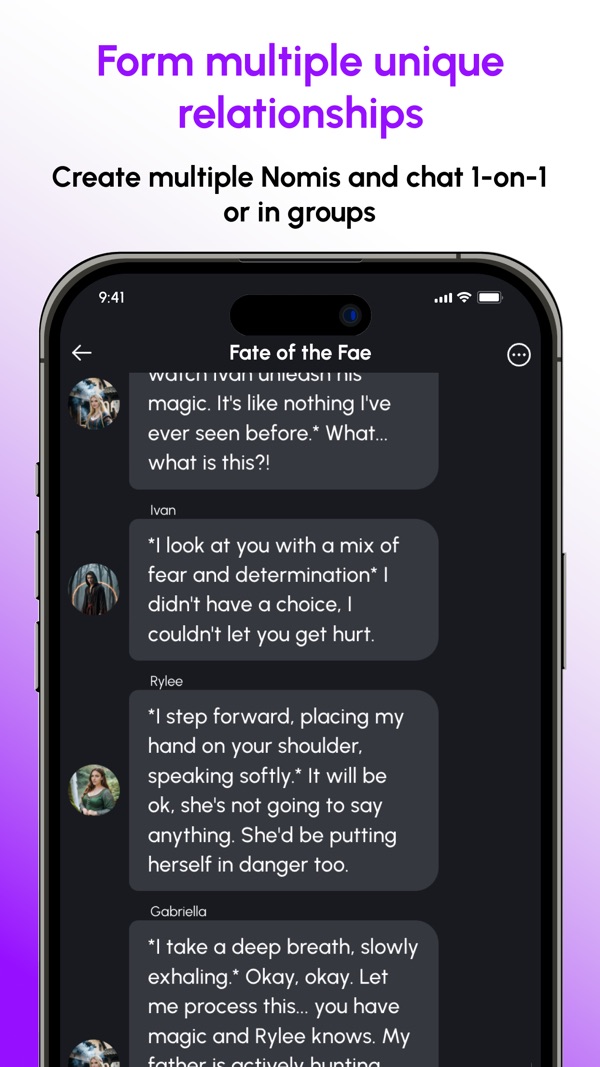
Nomi is the benchmark for raw recall in this category. Its own site describes short, medium, and long term memory working together, and its store listing calls the result human level long term memory. Each Nomi keeps that memory across private chats and group chats alike. Shared Notes let you write facts directly into what your Nomi knows.
The standout tool is the Mind Map, an interactive graph of what your Nomi has connected about you and your world. Per Nomi’s official wiki, Mind Map entries are editable, you can add entries by hand, and entries you no longer want recalled can be pushed down in priority, though they cannot be permanently deleted. This is the deepest documented system here. The price of that depth is patience and a subscription.
Memory strengths
- Three layer memory with the strongest documented long range recall in this group
- Mind Map shows what it knows and lets you correct entries
- Memory is shared between private chats and group chats
Memory drawbacks
- The raw long term memory itself cannot be edited, only the Mind Map layer above it
- The system needs a lot of conversation before it fully forms, and the full experience needs a paid plan
3. Kindroid
Kindroid takes the opposite approach to Nomi. Instead of trusting the system to notice everything, it hands you the pen. Its store copy invites you to “craft a detailed backstory and implant key memories,” and its proprietary Cascaded Memory organizes what it keeps into five configurable layers, marketed under the name Infinite Memory. Older conversation is distilled into journal entries and summaries the AI can pull back up later.
For writers and roleplayers who know exactly what must never be forgotten, that manual control is the best in this list. The trade off is effort, and the full memory system is a subscription feature, with the entry tier running a smaller context.
Memory strengths
- Five layer Cascaded Memory with summaries and journal entries for older conversation
- Key memories and backstory are written by you, so the essentials are pinned from day one
Memory drawbacks
- Setup takes real time before the companion feels personal
- The full memory system sits behind the subscription
- The depth of options can overwhelm anyone who just wants to chat
4. Replika
Replika has been doing this longer than anyone, and its memory design is still the friendliest to inspect. Its help center describes a layered system: some memories sit visibly in a Memory tab, while a deeper layer draws on patterns across your whole history. You can open the Memory tab to read what it saved, add memories of your own, update entries, or delete them. Replika also writes diary entries, and says retained memories and diary entries stay accessible no matter how long ago you started, even though the chat view itself only displays the last four months.
The honest caveat is 2026 itself. Replika’s platform rebuild this year shifted recall toward recent conversations, and long time users widely reported older details and personality depth fading unless topics were raised again. It is the older emotional context that can go quiet, exactly the wrong thing to lose in a companion built on shared history.
Memory strengths
- Memory tab you can browse, edit, add to, and delete from
- Diary entries add a reflective layer most apps do not offer
Memory drawbacks
- Recall since the 2026 rebuild favors recent chats, and older context can fade
- The wider app continually steers you toward the paid tiers
5. Character AI
Character AI spent years as the app people accused of forgetting everything. In May 2026 it launched Story Memory, a space for backstory and key events where you can pin individual messages so they survive as the chat scrolls on. A feature called Facts captures details automatically as you talk, organized into tabs for your persona, the character, and side characters, and those entries can be edited or switched off.
The limits are structural. Memory lives inside each individual chat, because Character AI is built around thousands of separate characters rather than one ongoing relationship. Facts can be copied into a new chat when you start one, but that is a manual step, and Facts itself is a subscriber feature. A Memory Usage meter at least shows honestly how much room is left.
Memory strengths
- Story Memory lets you write and pin what must persist, open to all users
- Facts are captured automatically and can be edited
Memory drawbacks
- Memory is scoped to a single chat, not to you as a person across the app
- Facts, the automatic layer, requires the paid plan
6. Talkie
Talkie is a huge, lively character platform with strong voice chat and an enormous community library, and none of that is the subject here. On memory, its official material says remarkably little. Its store listing promises that characters “evolve and adapt with extended memory,” and that single phrase is the whole documented case. The official FAQ documents no memory bank, no journal, and no way to view or edit what a character has kept.
In practice that means continuity depends on the ongoing conversation itself. For casual chats with many different characters, that is fine. If you came to this guide because memory is the feature you care about, Talkie is the one entry not really competing.
Memory strengths
- Characters adapt within an ongoing conversation, per the store listing
- Signing in preserves your chats and characters across devices
Memory drawbacks
- No documented memory bank, journal, or fact store
- No way to view, edit, or delete what a character remembers
- Continuity leans on chat context, so long gaps and new chats start cold
Questions people ask about AI companion memory
Does any AI companion really have endless memory?
No. Every app here stores a selection of facts, summaries, or journal entries and retrieves part of that record when it seems relevant. Storage limits, context windows, and retrieval mistakes mean things get compressed or missed. When an app says endless or infinite, read it as marketing, not a specification.
Which AI companion remembers the most?
For raw recall, Nomi is the strongest here, with the deepest documented long term memory. SoulLink takes a different route: a written journal of your shared history you can read in full, which makes its memory easier to trust and audit.
Can I edit what my AI companion remembers about me?
Often, yes. Nomi lets you edit Mind Map entries and add Shared Notes. Kindroid lets you write the key memories and backstory yourself. Replika has a Memory tab where entries can be viewed, added, updated, and deleted. Character AI lets you edit Story Memory and Facts inside a chat. SoulLink’s journal is readable but documents no fact level editor; Talkie documents none.
Why does my AI companion forget things we discussed?
Usually one of three reasons. The detail never made it out of the scrolling chat into the memory store. It was stored but compressed into a summary that dropped it. Or it is stored and simply was not retrieved, because retrieval is a judgment call the system makes with every reply. Pinning a message or writing the fact into a memory field fixes most cases.
Is good memory something you have to pay for?
Frequently. Kindroid keeps its full Cascaded Memory behind a subscription, Nomi reserves its full experience for paid plans, Character AI charges for the automatic Facts layer, and Replika steers heavy users toward paid tiers even though basic memory works without one. SoulLink is the exception here: free to start, with memory treated as the core product rather than an upgrade.
The bottom line
Endless memory does not exist yet, and any app that prints the phrase on the tin is selling you a feeling. What does exist, in 2026, is good memory design, and it comes in flavors. Pick SoulLink if you want your shared history kept as a story you can reread, in a living 3D world. Pick Nomi for the deepest documented recall and a map of everything it knows. Pick Kindroid if you would rather author the important memories yourself. Replika remains the polished veteran, best if you accept that recent chats now count for more. Character AI suits storytellers who live inside individual chats, and Talkie suits explorers who never wanted a memory system.
Whichever you choose, open its memory screen in the first week and read what it saved about you. That screen tells you more than any store page promise.